
The Rise of the Authoritarian Right in the World and South Africa
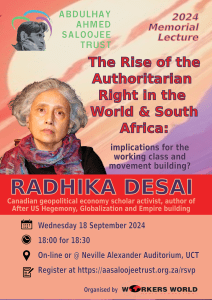
The 2023 annual Abdulhay Saloojee lecture and discussion was delivered by Radhika Desai on:
- DATE: Wednesday 18 September 2024
- TIME: 18h00 for 18h30
- VENUE: UCT, Cape Town
In 2024, the African National Congress lost its majority thirty years after delivering South Africans from the hated apartheid regime thanks to its decades-long adherence to corporate neoliberal policies. They thwarted not only the hopes awakened by the end of apartheid but also far more modest hopes for a decent life among South Africa’s working people. Worse, the discontents of the ANC’s neoliberalism were mobilised not by a well-organised left, which might have put the country back on the track of fulfilling popular hopes, but by political forces which appear to closely resemble the authoritarian populist right-wing politics of Trump, Johnson, Le Pen, the Alternative für Deutschland and similar forces that have emerged over the past decades around the neoliberal world.
In this lecture, Desai argued that over the previous four and a half decades, neoliberalism became the testing ground for the thesis that democracy and capitalism go hand in hand and gave it a failing grade. When capitalism and democracy appeared to work well in the Western world in the three decades after the Second World War, capitalism was heavily modified by the ‘socialistic’ measures – full employment policy, the welfare state, considerable public ownership, capital controls, strong trade unions and the like – that those countries had been forced to take thanks to the unprecedented mobilization of working people, and even then democracy had to be supplemented by heavy doses of repression.
The onset of neoliberalism, which had progressively peeled away the ‘socialistic’ measures, has been accompanied by the ‘hollowing out of Western Democracy’, leading to a generalised crisis of capitalist rule, and as in that other one in the interwar years, which coincided with the onset of mass politics, the rise of fascistic tendencies. Any serious left has not only been the target of neoliberal attack but has suffered from loss of political nerve and, as a result, the denizens of neoliberal polities are left to choose between corporate neoliberalism and the authoritarian right. No wonder fewer and fewer of them are voting.
Desai reflects on this denouement and what it means for South Africa in particular and on what sort of left mobilization might transform the political horizon into a more hopeful one.
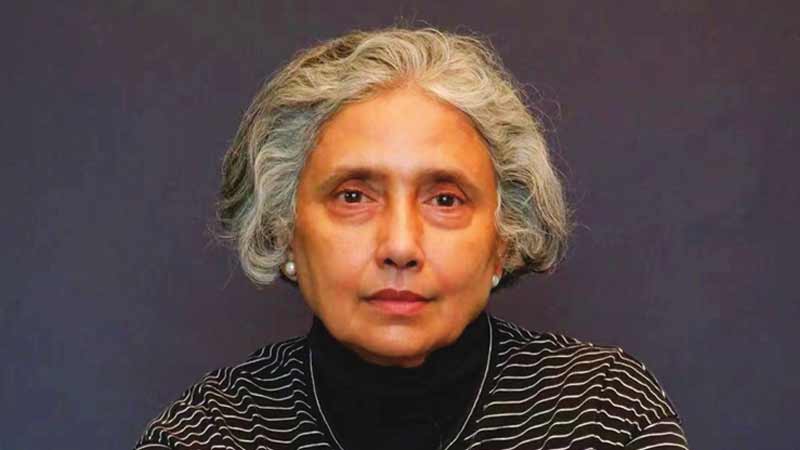
About the Speaker
Radhika Desai is Professor at the Department of Political Studies, Director, Geopolitical Economy Research Group, University of Manitoba, Winnipeg, Canada and Convenor of the International Manifesto Group. Her teaching and writing spans comparative politics, political theory, political economy and international affairs. She proposed a historical materialist approach to understanding world affairs in her Geopolitical Economy: After US Hegemony, Globalization and Empire (2013) and an original framework for understanding party politics in India in the context its evolving political economy and social transformation in various writings.
She has published dozen books, over 100 articles and book chapters on UK, Indian, US and European politics as well as on international political economy. Her books and articles have been translated into Chinese, French, German, Turkish and Spanish. She is a regular opinion contributor to and her pieces have been published in CGTN, Counterpunch, Frontline, The Guardian, the Hindu, RT and the Valdai Discussion Club. She hosts a fortnightly show, Geopolitical Economy Hour on the Geopolitical Economy Report website. Her most recent book is Capitalism, Coronavirus and War: A Geopolitical Economy (2022, Open Access).